The Benazir Income Support Programme continues to transform lives across Pakistan through its innovative 8171 service. This comprehensive guide covers everything you need to know about checking your eligibility, understanding payment schedules, and navigating the digital transformation of Pakistan’s largest social safety net.
Understanding the 8171 Online Portal System
The 8171 web portal represents Pakistan’s commitment to modernizing social welfare delivery. This digital platform allows millions of beneficiaries to verify their status, check payment dates, and update information without visiting physical offices. The system processes over 9 million active beneficiaries and has become the primary gateway for accessing BISP services.
Unlike traditional welfare systems that required extensive paperwork and long waiting periods, the 8171 web portal provides instant verification through multiple channels including SMS, online portals, and mobile applications.
How to Check Your BISP Eligibility Through 8171
Method 1: SMS Verification (Most Reliable)
The fastest way to verify your BISP status remains the SMS system. Simply compose a new message with your 13-digit CNIC number (without dashes) and send it to 8171. Within seconds, you’ll receive a response indicating:
- Your current eligibility status
- Payment amount you’re entitled to receive
- Next scheduled payment date
- Registration status in the NSER database
This method works across all Pakistani mobile networks including Jazz, Telenor, Zong, and Ufone.
Method 2: Online Portal Check
For detailed information beyond basic eligibility, beneficiaries can visit the 8171 web portal and enter their CNIC number in the verification form. The online system provides:
- Complete household survey information
- Poverty score (PMT score) details
- Payment history for the last 12 months
- Instructions for updating personal information
- Nearest BISP office locations
Method 3: BISP Mobile Application
The official BISP mobile app allows beneficiaries to check their status on the go. Available for Android devices, the app requires one-time CNIC verification and provides push notifications about payment releases and program updates.
2026 Payment Structure and Amounts
BISP has adjusted its financial assistance to help families cope with economic challenges. Here’s the updated payment structure:
Standard Quarterly Payment: PKR 13,500 per beneficiary Enhanced Support (Special Categories): PKR 14,500 for persons with disabilities and other vulnerable groups Education Stipend: Additional PKR 750 per child for families enrolled in Waseela-e-Taleem
Payments are released quarterly, with four disbursement cycles throughout the year. The exact dates vary by district but typically follow this pattern:
- Quarter 1: January – March
- Quarter 2: April – June
- Quarter 3: July – September
- Quarter 4: October – December
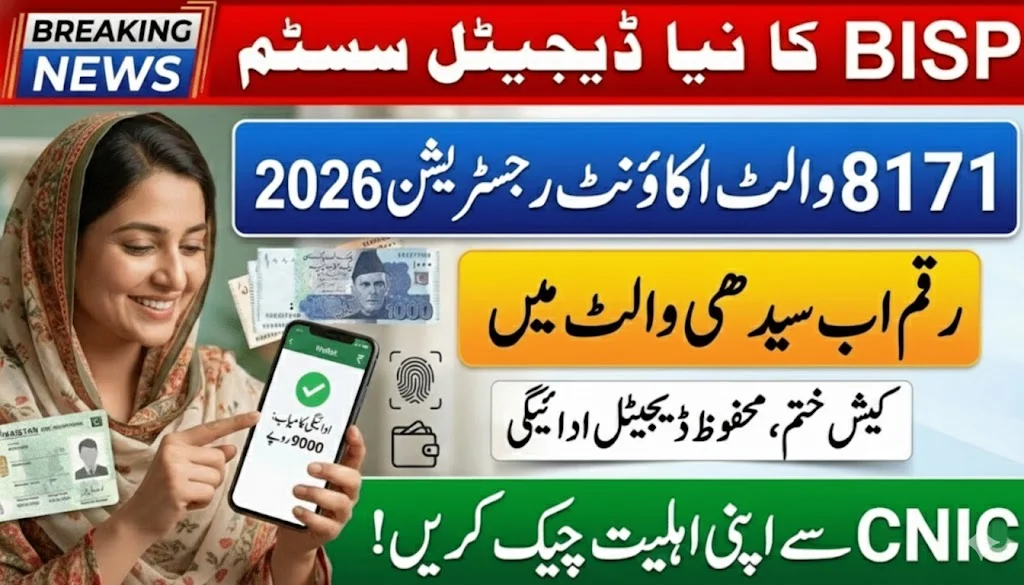
Digital Wallet Integration and Registration Process
The transformation from cash payments to digital wallets marks a significant evolution in BISP operations. This section explains how the new system works and how beneficiaries can transition smoothly.
Why Digital Wallets Matter
Traditional cash distribution faced numerous challenges including theft risks, long travel distances for rural beneficiaries, and opportunities for corruption. Digital wallets eliminate these issues by transferring funds directly to beneficiaries through mobile money services or bank accounts.
Step-by-Step Wallet Registration
Phase 1: Eligibility Confirmation
Before registering for digital payments, verify your eligibility through the 8171 web portal. Confirmed beneficiaries receive SMS notifications instructing them to complete wallet registration.
Phase 2: Documentation Preparation
Gather these essential documents:
- Original CNIC (valid and not expired)
- Mobile phone with SIM registered on your CNIC
- Children’s B-Forms for households with school-age children
- Previous BISP payment receipts (if available)
Phase 3: Biometric Enrollment
Visit your nearest Union Council office or designated BISP registration center. Staff will:
- Verify your identity through NADRA database
- Capture thumbprint for biometric authentication
- Link your mobile number to your BISP account
- Activate your digital wallet profile
The entire process takes approximately 15-20 minutes per beneficiary.
Phase 4: Wallet Activation
Once biometric verification completes, your wallet activates within 48-72 hours. You’ll receive confirmation via SMS containing:
- Wallet account number
- Instructions for accessing funds
- Customer service contact information
- Security tips for protecting your account
Partner Financial Institutions
BISP has partnered with multiple financial service providers to ensure nationwide coverage:
- JazzCash (Mobilink Microfinance Bank)
- Easypaisa (Telenor Microfinance Bank)
- HBL Konnect (Habib Bank Limited)
- Allied Bank Digital Wallet
- MCB Lite (Muslim Commercial Bank)
Beneficiaries can choose any partner based on availability in their area and personal preference.
NSER Dynamic Survey: The Foundation of Eligibility
The National Socio-Economic Registry (NSER) serves as the backbone of BISP’s targeting system. Understanding how NSER works helps beneficiaries maintain their eligibility and resolve issues quickly.
What NSER Measures
The survey evaluates household poverty through multiple indicators:
Housing Conditions: Construction materials, number of rooms, access to electricity and gas Assets Ownership: Vehicles, agricultural land, livestock, electronics Income Sources: Employment status, business ownership, remittances Education Levels: School attendance, literacy rates within household Health Factors: Access to healthcare, presence of disabled family members
These factors combine to generate a Proxy Means Test (PMT) score. Households scoring below the official threshold qualify for assistance.
Updating Your NSER Information
Life circumstances change, and BISP recognizes this reality. Beneficiaries can request NSER updates when:
- Family size changes (births, deaths, marriages)
- Income sources are lost or reduced
- Housing conditions deteriorate
- Household members become disabled or chronically ill
To update your survey, visit your local BISP office with supporting documentation. Updated surveys undergo verification before affecting eligibility status.
Troubleshooting Common 8171 Issues
“CNIC Not Found” Error
This message appears when:
- CNIC number entered incorrectly (check for typos)
- Recent change in CNIC due to marriage or correction
- No NSER survey exists for your household
Solution: Visit the 8171 Ehsaas Program support section or contact your nearest tehsil office to verify your CNIC status in the system.
Biometric Verification Failures
Fingerprint matching sometimes fails due to:
- Worn fingerprints from manual labor
- Injuries or skin conditions affecting fingers
- Outdated biometric data in NADRA records
Solution: Update your biometric information at any NADRA office. Bring your CNIC and explain the verification issue. NADRA will recapture your fingerprints and update the national database within 7-10 business days.
Payment Delays or Suspensions
Payments may be delayed when:
- Biometric verification remains incomplete
- NSER data requires updating
- CNIC has expired
- Duplicate registrations detected in the system
Solution: Check your exact status through SMS to 8171. The response message will indicate the specific reason for any hold. Address the identified issue at your Union Council office.
SIM Registration Problems
Digital wallets require SIMs registered on the beneficiary’s own CNIC. Many women face challenges as family SIMs are registered under male relatives’ names.
Solution: Visit any franchise of your mobile network operator with your CNIC. Request SIM registration or transfer. The process is free and takes about 30 minutes. Some BISP offices now offer on-site SIM registration assistance.
Security Measures and Fraud Prevention
As BISP moves toward digital systems, protecting beneficiary information becomes crucial. Follow these essential security practices:
Recognizing Official Communication
Legitimate BISP Contact:
- SMS from 8171 short code only
- Official emails from @bisp.gov.pk addresses
- Calls from published BISP helpline numbers
- In-person visits to registered BISP offices
Warning Signs of Fraud:
- Calls from private mobile numbers claiming to be BISP
- Requests for payment to “activate” or “process” benefits
- Demands for CNIC photocopies via WhatsApp or email
- Promises of increased payments in exchange for fees
- Messages containing suspicious links or APK files
Protecting Your Wallet Account
Never share these details with anyone:
- Mobile wallet PIN codes
- OTP (one-time passwords) received via SMS
- Biometric information or thumbprint scans
- CNIC photocopies unless at official offices
If you suspect your wallet has been compromised, immediately contact your wallet provider’s customer service and report the issue to BISP helpline.
Provincial Variations and Special Programs
While BISP operates nationally, some provinces have introduced complementary programs that beneficiaries should know about:
Punjab
The Punjab Social Protection Authority offers additional support including education vouchers and skills training. BISP beneficiaries often qualify automatically for these programs.
Sindh
Sindh maintains separate social safety nets but coordinates with BISP to avoid duplication. Beneficiaries can check eligibility for provincial programs without affecting BISP status.
Khyber Pakhtunkhwa
KP has integrated disaster relief with BISP systems, allowing rapid response during emergencies. The 8171 check online cnic displays emergency assistance eligibility for affected districts.
Balochistan
Given geographical challenges, Balochistan receives special attention with mobile registration teams visiting remote areas quarterly. Digital wallet adoption is phased to accommodate limited mobile network coverage.
Education Support Through Waseela-e-Taleem
BISP beneficiaries with school-age children receive additional support to encourage education:
Primary Level (Ages 5-12): PKR 750 per child per quarter
Secondary Level (Ages 13-18): PKR 1,500 per child per quarter
To enroll in Waseela-e-Taleem:
- Confirm your BISP eligibility status
- Visit designated enrollment centers (usually at district education offices)
- Provide children’s B-Forms and school enrollment certificates
- Complete biometric verification for both parent and children
Education stipends are paid separately from regular BISP assistance, directly into the beneficiary’s wallet account.
Looking Ahead: BISP’s Digital Future
The program continues evolving with planned enhancements for 2026 and beyond:
Artificial Intelligence Integration: Automated fraud detection systems will identify suspicious patterns in real-time, protecting genuine beneficiaries from identity theft.
Expanded Partner Network: More mobile wallet providers and microfinance banks will join the system, improving access in underserved areas.
Real-Time Updates: Beneficiaries will receive instant notifications about eligibility changes, payment releases, and program updates through mobile app push notifications.
Self-Service Portal Expansion: The enhanced portal will allow beneficiaries to update limited information directly, request document corrections, and schedule office appointments online.
Frequently Asked Questions
Q: How often should I check my 8171 status?
A: Check before each quarterly payment cycle begins. If you’re expecting a payment, verify your status 2-3 weeks before the scheduled distribution date.
Q: Can I use someone else’s phone to register my SIM for the wallet?
A: No. For security and verification purposes, the SIM must be registered on your own CNIC at a mobile network franchise.
Q: What happens if I miss a quarterly payment?
A: Missed payments aren’t automatically forfeited. Visit your BISP office with your CNIC to inquire about pending payments. In most cases, you can still collect previous quarters after resolving any eligibility issues.
Q: Does having a smartphone affect my eligibility?
A: Basic smartphones (below PKR 30,000) don’t impact PMT scores. However, expensive devices or multiple high-value electronics might affect future NSER surveys.
Q: Can I receive BISP if my husband is employed?
A: Employment alone doesn’t disqualify households. Eligibility depends on total household income, assets, and living conditions assessed through PMT scoring. Low-wage employment doesn’t automatically exceed the threshold.
Q: How do I find my nearest registration center?
A: The office locator feature on the official platform shows all registration points by district. Alternatively, send “OFFICE” to 8171 to receive SMS with nearest center details.
Conclusion
The BISP 8171 system represents Pakistan’s commitment to transparent, efficient, and dignified social protection. By understanding how to navigate the digital tools available, beneficiaries can access their entitlements smoothly while avoiding fraud and delays.
For the most current information about eligibility criteria, payment schedules, and registration procedures, always rely on official sources. The transition to digital payments may seem challenging initially, but the long-term benefits of security, convenience, and transparency make it worthwhile for Pakistan’s most vulnerable families.
Stay informed, protect your personal information, and utilize available support services to ensure continuous access to this vital assistance program.
Disclaimer: This guide provides general information based on current BISP policies. Individual circumstances may vary. Always verify specific details through official BISP channels before making decisions.